Overview
The Intermediate Housing Model (IHM) is a spatial design framework that sits between two familiar extremes — fully private dwellings and highly communal housing models such as co-living.
Fully private housing can lead to isolation, while highly communal living can feel socially demanding.
IHM explores the space between, where the scale of sharing and degree of choice are carefully balanced. It prioritises private homes, complemented by small-scale shared spaces embedded in everyday routines — allowing interaction to occur by choice rather than obligation.
Instead of prescribing community, IHM creates the conditions for connection, autonomy, and choice to coexist.
IHM Model
The Intermediate Housing Model (IHM) operates as a scalable system — linking spatial design, social outcomes, and delivery from dwelling to neighbourhood.
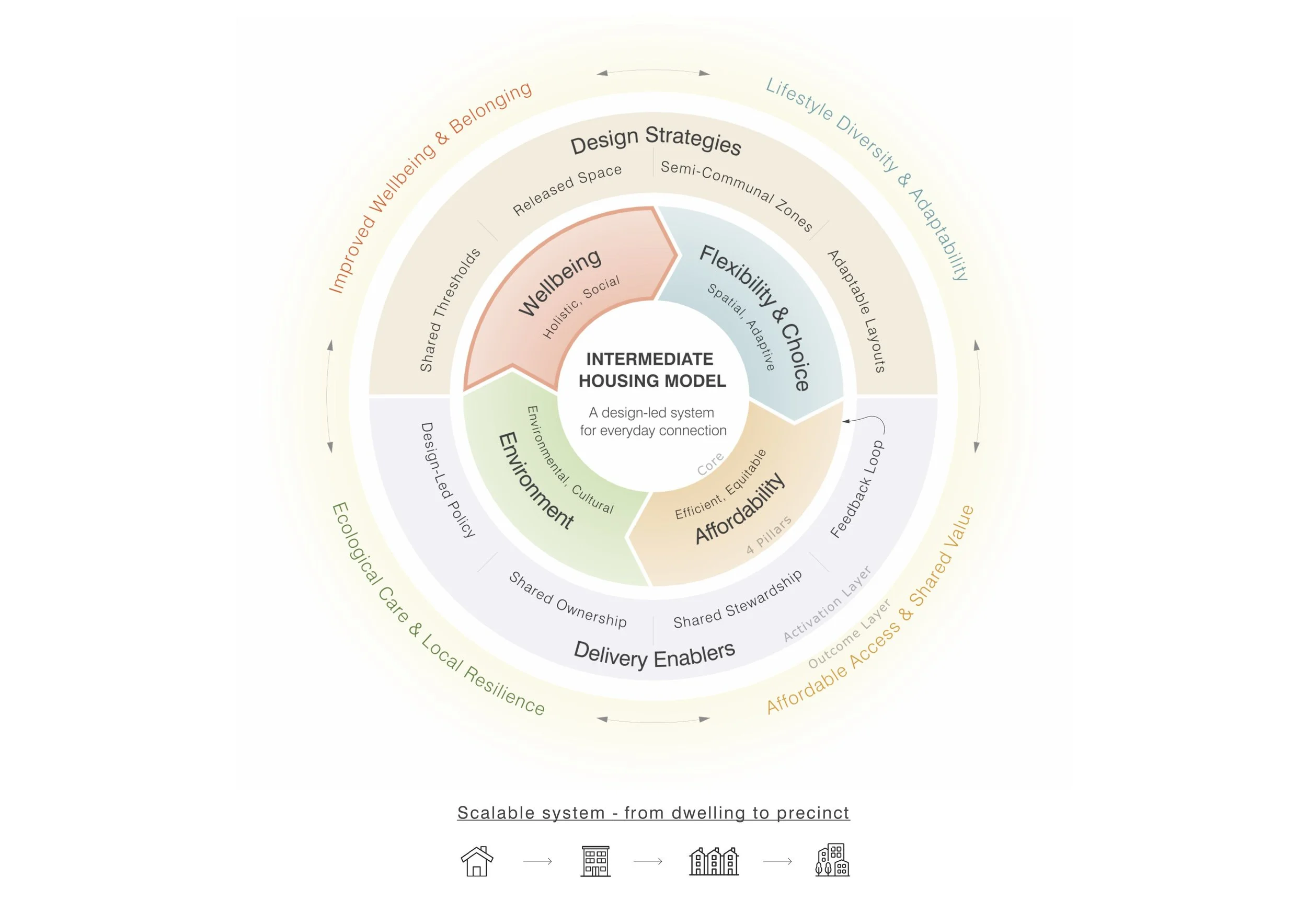
Four core pillars are coordinated through design strategies and delivery enablers to support diverse housing types and living arrangements.
Explorations
The following studies test how IHM principles translate into spatial strategies across different scales — from outdoor space to circulation, domestic functions, and complete dwelling layouts.
1. Shared Backyard
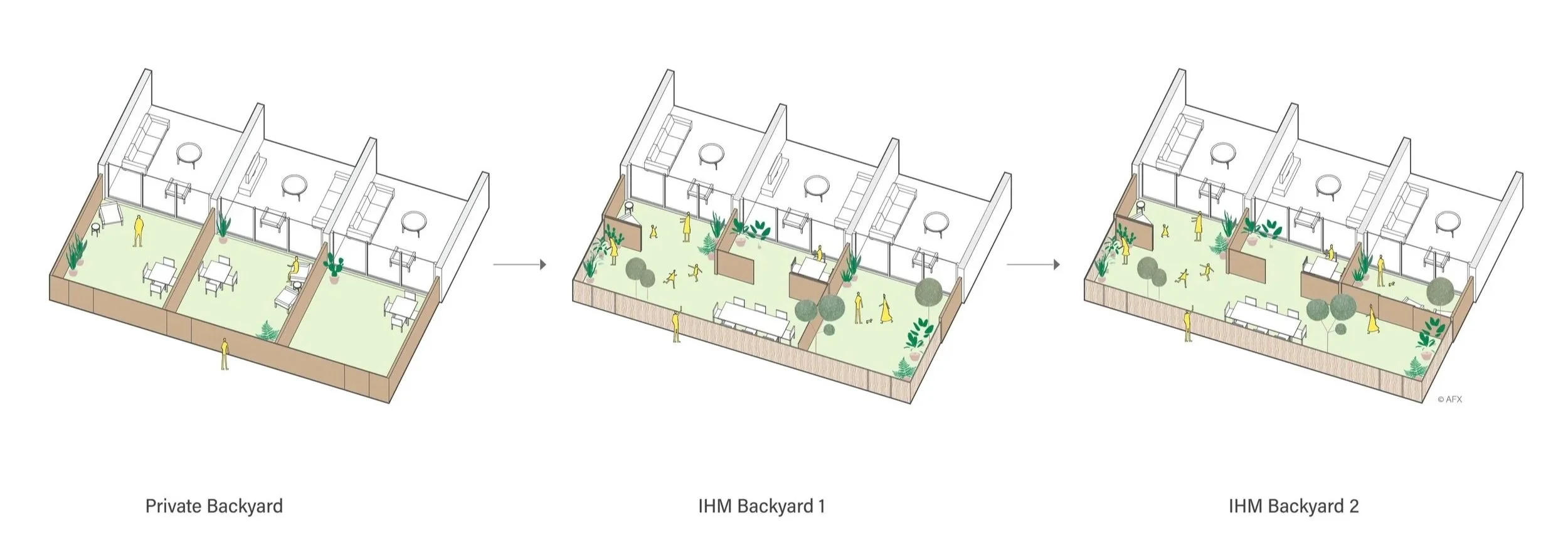
Backyards are typically treated as fully private, with strict boundaries between households.
Here, space is redistributed — retaining a private portion while combining the remainder into a shared landscape. Within the same footprint, usable outdoor area is expanded rather than duplicated.
Operable thresholds allow residents to engage or retreat by choice, while lowered fences extend visual connection to the wider neighbourhood.
2. Kitchen as a Social Edge
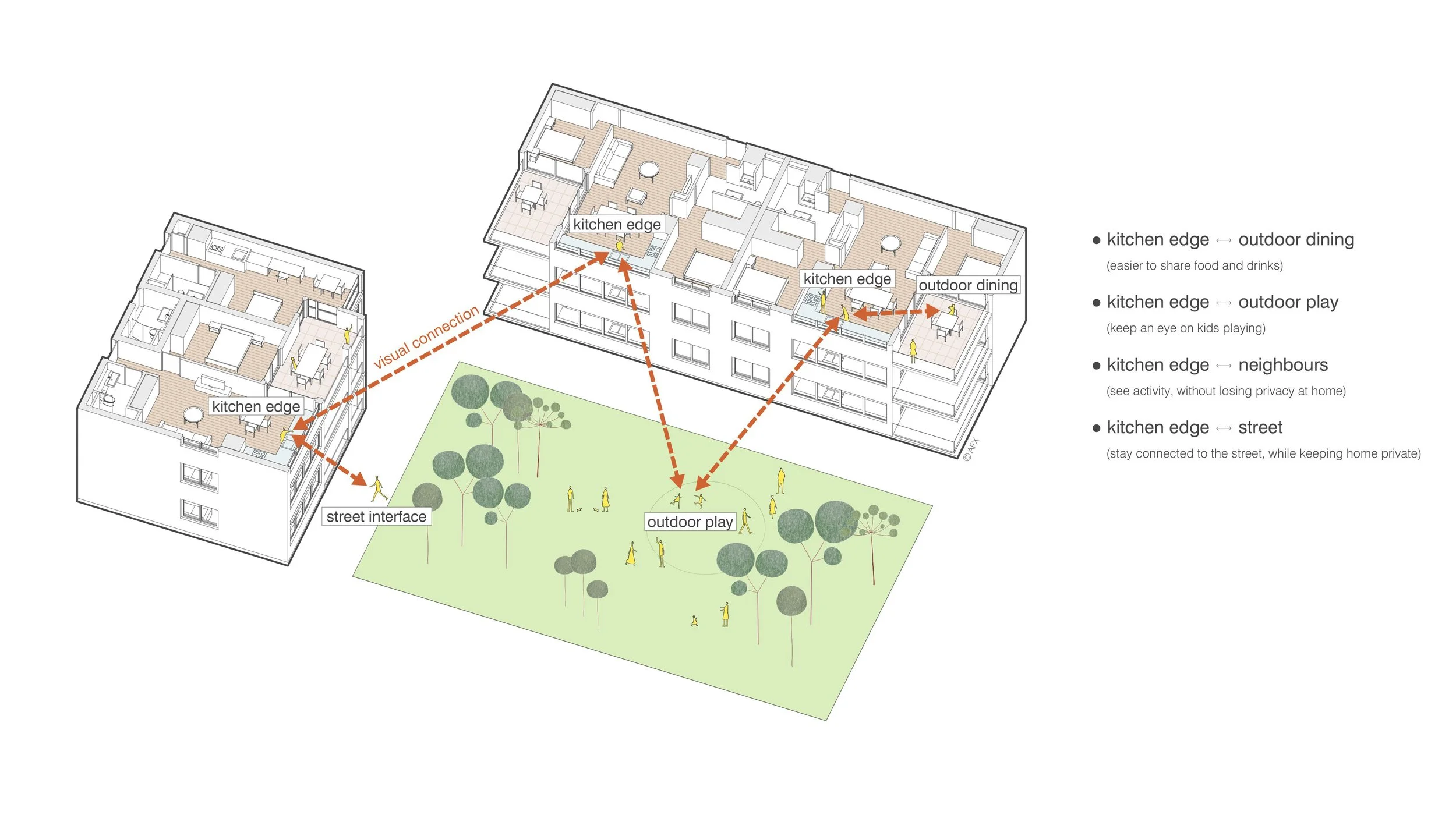
Kitchens are typically internalised, oriented toward the interior of the dwelling and disconnected from the surrounding environment.
Here, the kitchen is positioned at the edge, establishing visual connections to adjacent outdoor and shared spaces. In this role, it operates as a threshold—supporting everyday visibility and engagement with the neighbourhood while maintaining the privacy of primary living areas.
3. Threshold Spaces
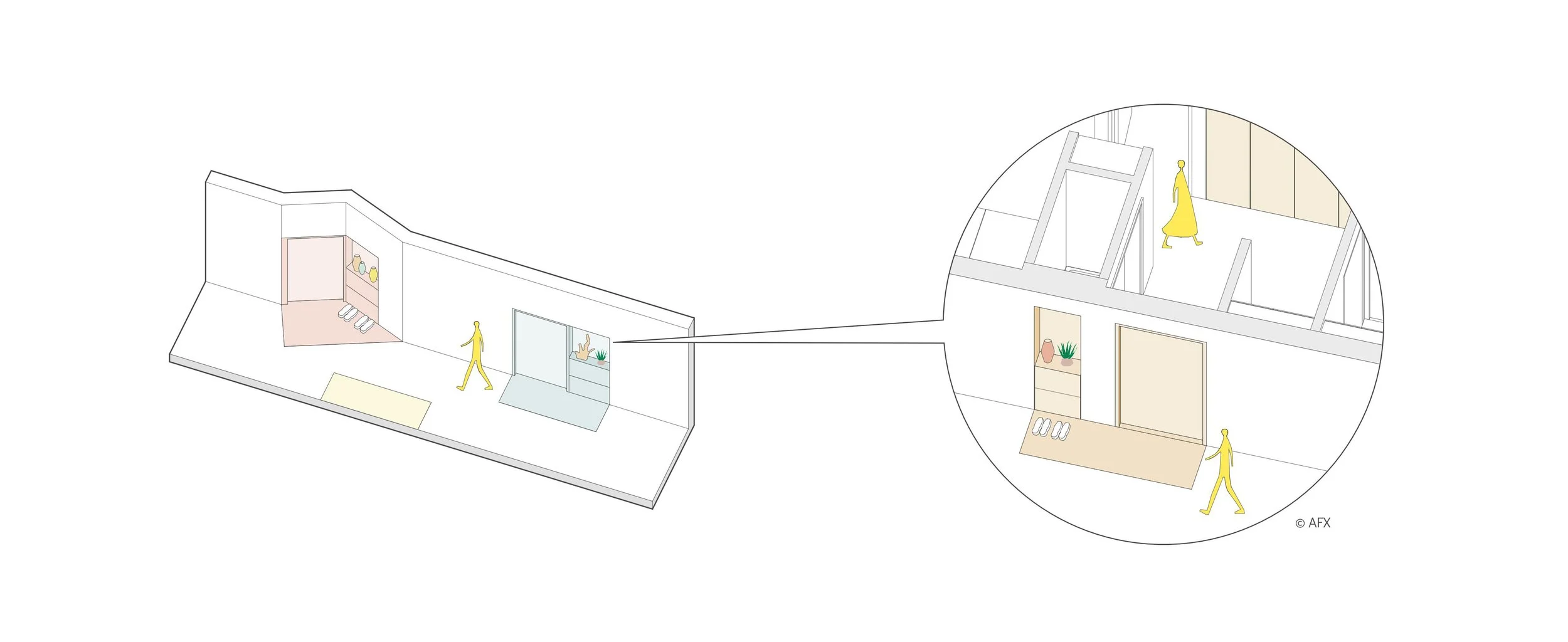
Corridors are typically treated as residual circulation — spaces to pass through, not inhabit.
Here, the corridor is thickened into a semi-communal threshold, incorporating alcoves, shared amenities, and porch-like edges that support everyday encounters between neighbours.
Interaction emerges through proximity rather than obligation, allowing residents to engage or pass through by choice.
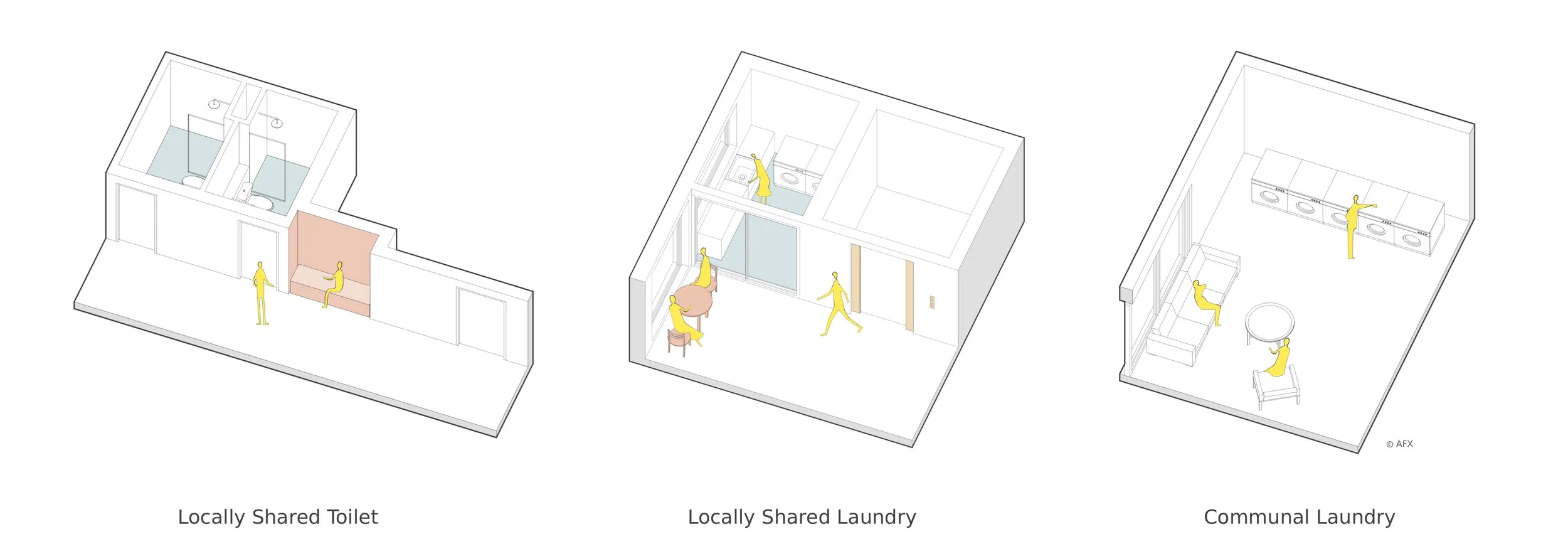
4. Shared Domestic Functions
Toilets and laundries are typically duplicated within each unit, reinforcing fully private living.
Here, they are redistributed into small-scale shared zones along circulation paths, supported by adjacent threshold spaces.
This reduces spatial duplication while freeing up private space, allowing shared use to be introduced where it is most effective.
5. Spatial Reconfiguration
Less Space, More Use
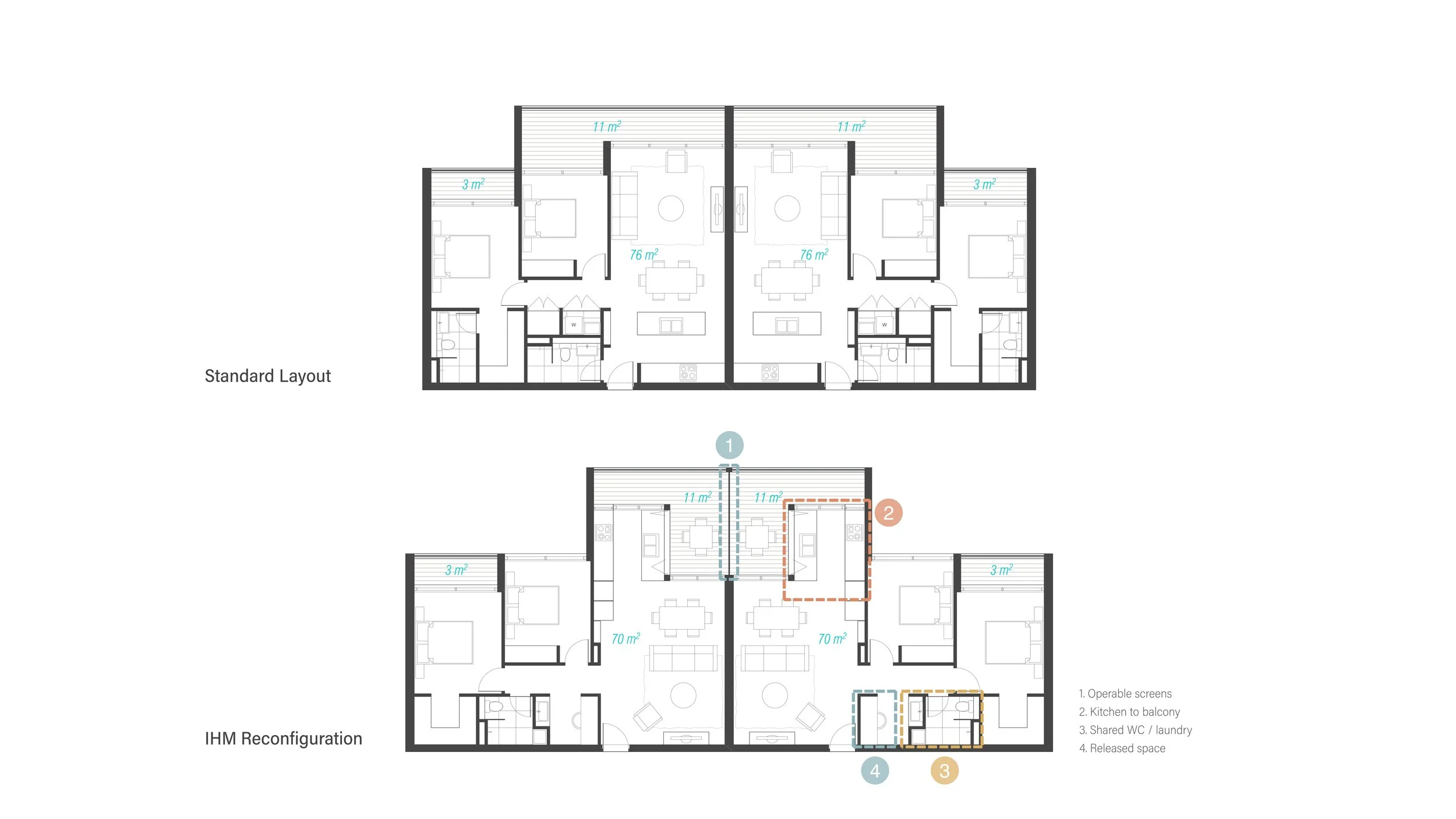
A typical two-bedroom apartment is reworked by redistributing space between private units and shared functions.
The kitchen is reoriented towards the balcony and street, balancing privacy with visual connection to the neighbourhood. Functions such as laundry and a secondary bathroom are relocated into shared zones, reducing duplication and releasing space within the unit.
Despite a smaller internal area, the layout accommodates additional functions and supports more flexible ways of living.
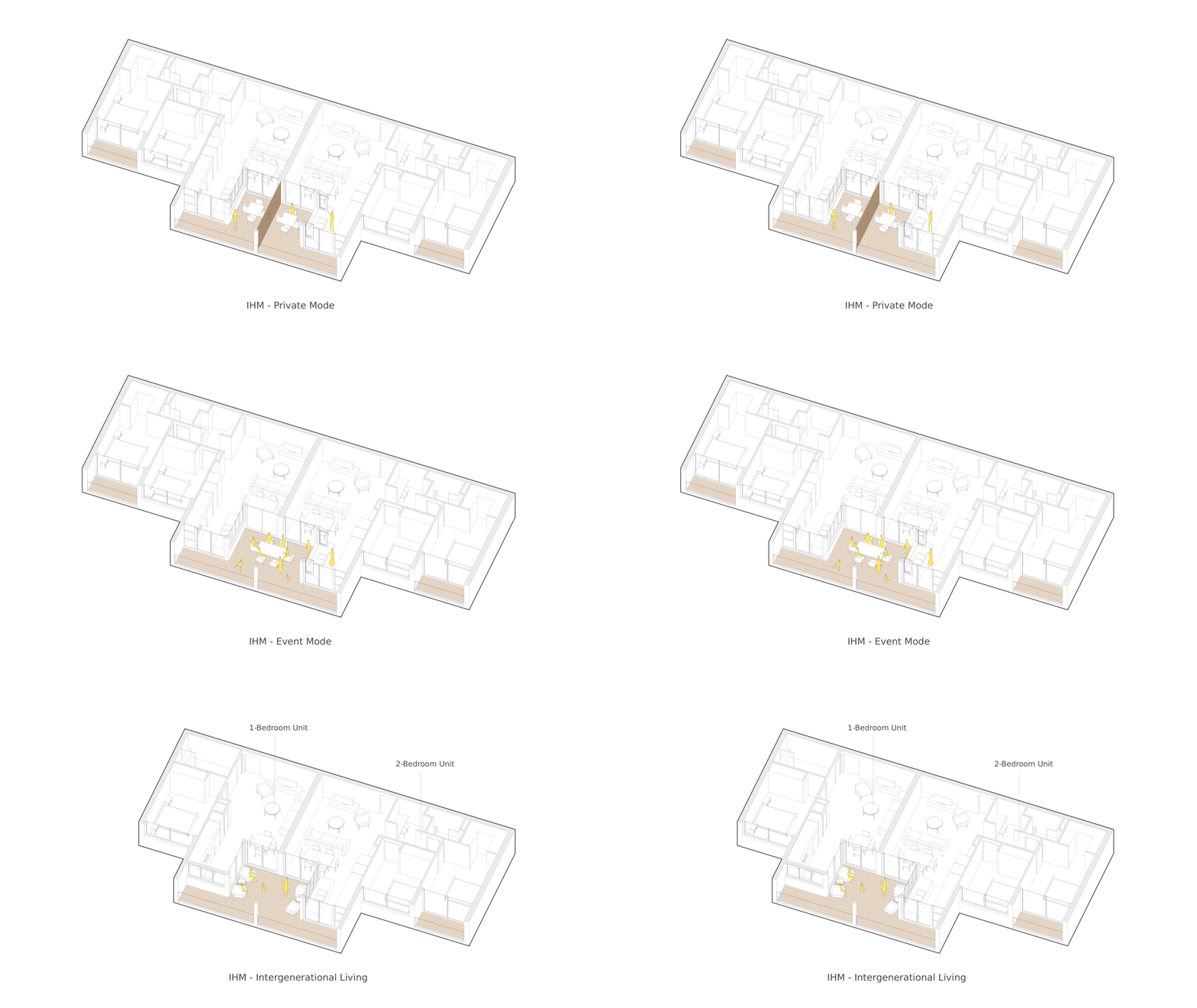
In plan, this establishes a more efficient spatial structure; in use, it enables the dwelling to operate in different modes.
In its default state, each dwelling maintains a clearly defined boundary, with an operable screen separating neighbouring balconies. When opened, this boundary becomes adjustable, allowing adjacent units to connect and operate as a shared space.
Privacy and sharing are not fixed, but can be negotiated over time by residents.
Writing
Selected writing exploring the ideas and questions underpinning the Intermediate Housing Model.
We Need Another Housing Option — between Isolation and Communes
Intermediate housing offers affordability, flexibility and connection – if we design for real lives, not just floor plans.
Published in The Fifth Estate, 8 July 2025
This article argues for a missing “in-between” housing model, as current housing options tend to favour either fully private dwellings or highly communal living. It introduces the Intermediate Housing Model (IHM) as a design-led approach that balances privacy, flexibility, and connection through everyday spatial arrangements.